Best Credit Cards for Streaming Services
Some links may earn a commission at no cost to you. See our full disclosure.
You know that moment when you look at your credit card statement and see $80+ in streaming charges? That was me. I was paying $80/month and just accepting it. Then I figured out how to cut it to $52—a 41% discount without sharing passwords.
American households spend an average of $69/month on streaming subscriptions, up 13% from last year.[1] Most people charge these to whatever card is in their wallet and earn 1-2% back. With the right setup, you can reclaim $400-700/year.
Why are streaming prices rising? Netflix spends $17 billion on content annually. Disney+ lost $4 billion before raising prices. Most services are still unprofitable. See our deep dive: Streaming Economics: How Netflix, Disney+, and Every Major Service Make Money.
Here's how I actually do it, plus the best alternatives based on what cards you have (or are willing to get).
Two levels of optimization exist:
- Level 1 (everyone): Use a 5-6% cashback card instead of your default card. Saves $60-70/year.
- Level 2 (premium card holders): Stack statement credits + cashback. Saves $400-700/year, but only if you already have the cards for other reasons.
I know this sounds complicated. But it's really not once you set it up. Full disclosure: I spent way too long figuring this out so you don't have to.
Quick Answers
I know you're busy. Here's what you need to know:
Best overall (single card): Amex Blue Cash Preferred — 6% cashback + $120/year Disney credit (minus $95 AF = $25 net gain before cashback)
Best free card: Visa Max Cash Preferred or US Bank Cash+ — 5% on streaming, $0 annual fee
Best for set-and-forget optimizers: Citi Custom Cash — auto-applies 5% to your top category
Best combo (if you have Platinum for travel): Amex Platinum + Amex Blue Cash Preferred
- Platinum: $25/month entertainment credit ($300/year) + free Paramount+ or Peacock via Walmart+
- BCP: 6% cashback on all streaming + $120/year Disney credit
- Why BCP over 5% cards: Also earns 6% on groceries (up to $6k/year), making the $95 annual fee worth it beyond just streaming
- Important caveat: Only get Platinum if you already have it for travel. The $895 annual fee doesn't make sense for streaming alone.
10-year savings: $600 (5% card) to $4,300+ (Platinum stack, but only if you already have the card for travel)
The honest truth? Most people should start with Level 1. Level 2 only makes sense if you already have premium cards for other reasons.
My Streaming Setup: The Credit Stacking Strategy
Here's how I actually set this up, and why it took me way too long to figure out.
Credit stacking = using statement credits to offset subscription costs, then applying high-cashback cards to the rest. I use three cards, each doing a specific job. I tried using just one card first, but that didn't work—the credits and cashback rates work better when you stack them.
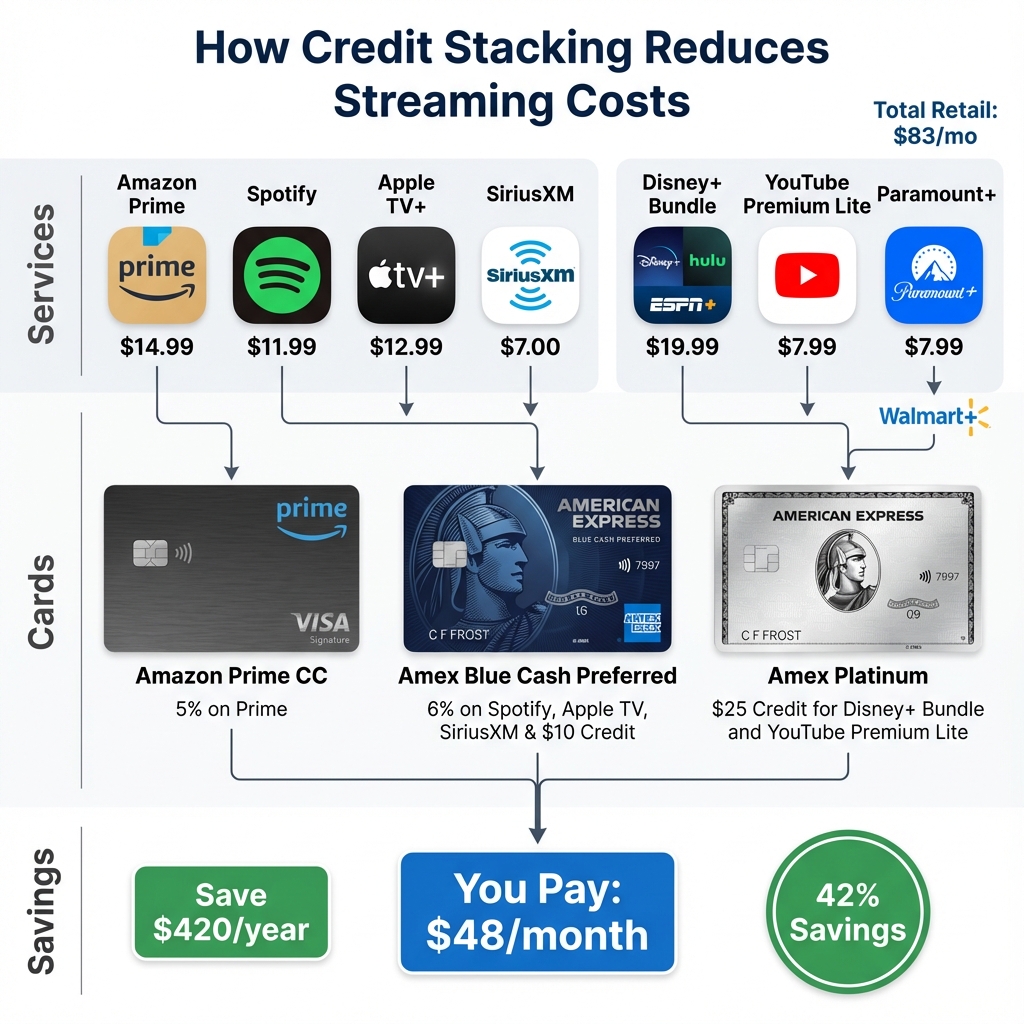
Visual breakdown of how credit stacking reduces $83/month streaming to $48/month
| Service | Retail Price | Card Used | Strategy | My Cost |
|---|---|---|---|---|
| Disney+ Bundle + Max | $19.99 | Amex Platinum | $25/mo entertainment credit | $0.00 |
| YouTube Premium Lite | $7.99 | Amex Platinum | Credit covers overflow | $2.99 |
| Paramount+ | $7.99 | Amex Platinum | Free via Walmart+ perk | $0.00 |
| Amazon Prime | $14.99 | Amazon Prime CC | 5% cashback | $14.24 |
| Spotify | $11.99 | Amex BCP | 6% cashback | $11.27 |
| Apple TV+ | $12.99 | Amex BCP | 6% cashback | $12.21 |
| SiriusXM | $7.00 | Amex BCP | 6% cashback | $6.58 |
| TOTAL | $82.94 | $47.89 |
Plus free access to Netflix, YouTube TV, and NYT through shared accounts.
How the 6% Cashback Adds Up
Here's the per-service breakdown showing how the 6% rate works in practice:
- Spotify ($11.99/month): $8.63/year cashback
- Apple TV+ ($12.99/month): $9.35/year cashback
- SiriusXM ($7.00/month): $5.04/year cashback
- Amazon Prime ($14.99/month): $10.79/year cashback (5% on Amazon card)
- Total cashback: ~$33/year from these services alone
The credits cover the rest. Disney bundle ($19.99) and YouTube Premium Lite ($7.99) are covered by the Platinum's $25/month credit, and Paramount+ is free via Walmart+.
The Streaming Math
- Retail value: $82.94/month ($995/year)
- What I pay: $47.89/month ($575/year)
- Annual savings: $420/year
- 5-year savings: $2,100
- 10-year savings: $4,200
That's real money. Enough for a weekend trip funded entirely by credit card optimization.
The Two Strategies: Credits vs. Cashback
There are really two ways to do this. And honestly, most people should start with Level 1.
Cashback Maximizing (Level 1)
Use the highest cashback rate possible on every streaming purchase.
- Requires: Amex BCP (6%) or any 5% card (Visa Max Cash Preferred, US Bank Cash+, Citi Custom Cash)
- Best for: Everyone else
- Savings potential: 5-6% cashback
Credit Stacking (Level 2)
Here's the thing about Level 2: it only works if you already have premium cards. Use cards with statement credits to make services free, then use high-cashback cards for the rest.
- Requires: Amex Platinum or similar premium card
- Best for: People who already have premium cards for travel
- Savings potential: 40-50% off retail
The key insight: Credit Stacking beats cashback maximizing only if you already have an Amex Platinum for other reasons. The math only works if you're already using the card for travel.
The Best Cards for Streaming (Ranked)
Premium & High Cashback Cards
Amex Platinum — $455+ in Annual Streaming Value
The Amex Platinum is amazing if you travel. But if you're getting it just for streaming? Don't.
- Annual fee: $895
- Streaming credit: $25/month ($300/year)[2]
- Walmart+ credit: $12.95/month ($155/year) → includes free Paramount+ or Peacock
⚠️ Enrollment Required: You must enroll in the Digital Entertainment Credit benefit in your Amex benefits portal before the credits will apply. Most people miss this step.
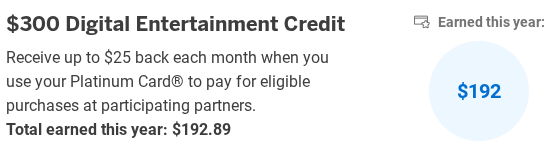
Amex Platinum's $25/month Digital Entertainment Credit covers Disney+, Hulu, YouTube, and more
The Walmart+ hack: Your Platinum includes free Walmart+ membership. Walmart+ includes Paramount+ (with ads) OR Peacock, and you can switch between them every 90 days. This is kind of ridiculous, but also kind of fun.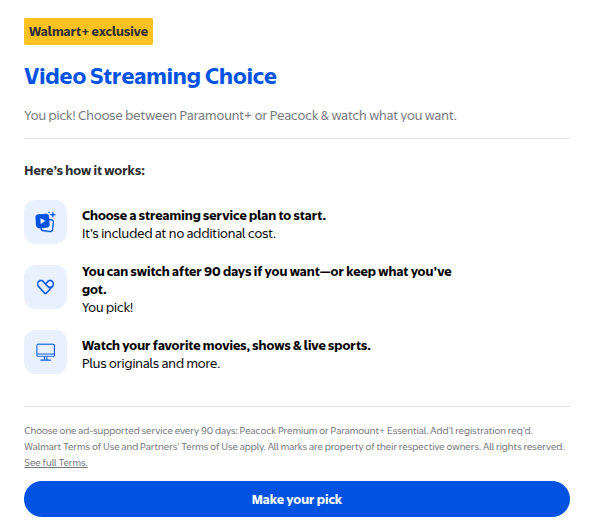
Walmart+ membership includes your choice of Paramount+ or Peacock, switchable every 90 days
Who should get this card: Only if you'll use the travel benefits (lounges, hotel status, airline credits). Don't get it just for streaming.
Who already has it: Use the full $25/month. Don't leave credits on the table. Seriously, I wasted credits for months before I realized I wasn't using them all.
I have this card (status: open).
Chase Sapphire Reserve — Free Apple Services
- Annual fee: $550
- Streaming benefit: Free Apple TV+ AND Apple Music (until June 22, 2027)
- Value: ~$250/year
⚠️ Activation Required: This isn't a credit. It's a full subscription. Activate in your Chase benefits hub. Most CSR holders don't know about this.
Amex Blue Cash Preferred — 6% Cashback King
- Streaming rate: 6% cashback (uncapped)[3]
- Annual fee: $95 (waived first year)
- Disney credit: $10/month ($120/year) — enrollment required

Amex Blue Cash Preferred offers 6% cashback on streaming plus a $10/month Disney credit (enrollment required)
The math for BCP alone:
- $50/month streaming × 6% = $36/year cashback
- Plus $120 Disney credit
- Minus $95 annual fee
- Net gain: $61/year
Per-service cashback example (realistic family setup):
- Netflix Premium ($24.99/month): $17.99/year cashback
- Spotify Family ($16.99/month): $12.23/year cashback
- Apple TV+ ($12.99/month): $9.35/year cashback
- Disney+ Bundle ($19.99/month): $14.39/year cashback (plus $120 credit)
- Total on $74.96/month: ~$54/year cashback + $120 Disney credit = $174/year value
The hidden 6% categories: Apple App Store and Google Play purchases code as streaming. In-app purchases, movie rentals, digital games. All 6%.
⚠️ Enrollment Required: You must activate the Disney streaming credit in your Amex benefits portal before using it. Then use your BCP to pay for eligible Disney+, Hulu, or ESPN+ subscriptions directly through their websites (disneyplus.com, hulu.com, or plus.espn.com). The $10/month credit appears as a statement credit after your purchase.
If you have both cards: Use Platinum's $25/month credit for Disney, not BCP's $10 credit. The Platinum credit covers the full Disney bundle (~$20) with room to spare. Using BCP's smaller credit leaves $15/month of your Platinum credit unused.
I have this card (status: open).
Best No-Annual-Fee Cards: 5% Streaming Options
Three cards offer 5% cashback on streaming with $0 annual fees, but they work differently:
US Bank Cash+ / Visa Max Cash Preferred (quarterly category selection)
- Streaming rate: 5% cashback[4]
- Annual fee: $0
- How it works: Select "TV, Internet & Streaming" as one of your two 5% categories each quarter
- Cap: $2,000 per quarter in combined category spending
- Best for: People who don't mind quarterly category activation
These cards are nearly identical. Visa Max Cash Preferred is issued by Elan Financial Services through various credit unions. US Bank Cash+ is the direct-from-bank version.
I have this card (status: open).
Citi Custom Cash (automatic category selection on highest spend category)
- Streaming rate: 5% cashback (automatic)[5]
- Annual fee: $0
- How it works: Automatically applies 5% to your top spending category each billing cycle. No activation needed.
- Cap: $500 per billing cycle ($25 max bonus)
- Best for: Set-and-forget optimizers who want 5% without remembering to activate categories
The difference: US Bank Cash+ requires you to actively select streaming as a category each quarter. Citi Custom Cash automatically gives you 5% on whatever you spend most on. If that's streaming, you get 5% without any action.
Which to choose: If streaming is consistently your highest spend category, Citi Custom Cash is simpler. If you want to control which categories get 5% (streaming + utilities, for example), US Bank Cash+ gives you more flexibility.
I have this card (status: open).
US Bank Altitude Go — $15 Annual Credit + 2x Points
- Streaming rate: 2x points (or $15 annual credit after 11 months)
- Annual fee: $0
- Best for: People who have the card for other reasons (4x dining, no foreign transaction fees)
The Altitude Go offers a unique benefit: $15 annual streaming service credit after 11 months of streaming purchases. This credit can exceed the value of 5-6% cashback if your monthly streaming spend is low enough.
The math:
- If you spend $10/month on streaming: $15 credit = 12.5% effective return
- If you spend $20/month: $15 credit = 6.25% effective return
- If you spend $30+/month: 5-6% cashback cards beat this
Who should get this: Only if you're already using the card for its 4x dining rewards. The $15 credit is a nice bonus, but not worth getting the card for streaming alone. Honestly, I think this card only makes sense if you're already using it for dining.
Who already has it: Make sure you're using it for streaming to earn the $15 credit after 11 months. That moment when you see the credit hit your statement? Pretty satisfying.
No-Fuss Cards (Set and Forget)
Capital One Savor — 3% Simple
- Streaming rate: 3% cashback[6]
- Annual fee: $0
- Bonus: Entertainment (concerts, movies) also 3%
No enrollment, no quarterly categories, no activation. Just use it.
Wells Fargo Autograph — 3x Multi-Category
- Streaming rate: 3x points
- Annual fee: $0
- Bonus: Also covers restaurants, gas, travel, transit, phone plans
One card that covers most bonus categories without annual fee.
I have this card (status: open).
Chase Sapphire Preferred — 3x Points on Streaming
- Streaming rate: 3x Ultimate Rewards points[7]
- Annual fee: $95
- Best for: Travelers who want to earn points instead of cashback
The Chase Sapphire Preferred earns 3x points on select streaming services. While this is lower than the 5-6% cashback rates, Ultimate Rewards points can be worth 1.25-2+ cents each when transferred to travel partners or redeemed through Chase Travel.
The math: At 1.5 cents per point (conservative valuation), 3x points = 4.5% value. If you value points at 2 cents each (travel redemptions), 3x = 6% value.
Who should get this: Only if you're already using the card for travel and dining (3x on both). Don't get it just for streaming. The 5% cashback cards are simpler and more valuable for streaming alone. I'll be honest: this card only makes sense if you're already in the Chase ecosystem for travel.
Who already has it: Use it for streaming if you're maximizing Ultimate Rewards points for travel. Otherwise, a 5% cashback card is more straightforward. The relief of not having to think about point valuations? That's worth something too.
Robinhood Gold Card — 3% Cashback
- Streaming rate: 3% cashback
- Annual fee: $5/month ($60/year), requires Robinhood Gold subscription
- Best for: Existing Robinhood Gold members
The Robinhood Gold Card earns 3% cashback on streaming, but requires a Robinhood Gold subscription ($5/month = $60/year). Only worth it if you already have Gold for other benefits (higher interest on uninvested cash, margin trading, research tools).
Who should get this: Only if you're already paying for Robinhood Gold. Don't get Gold just for the credit card. The 3% rate doesn't justify the $60/year fee on its own. Look, if you're not already using Gold for investing, this isn't worth it.
Who already has it: Use it for streaming if you're already a Gold member. Otherwise, the no-annual-fee 3% cards (Capital One Savor, Wells Fargo Autograph) are better.
I have this card (status: open).
Citi Double Cash — 2% Floor (Bare Minimum)
- Streaming rate: 2% cashback (1% when you buy, 1% when you pay)
- Annual fee: $0
- Best for: Everyone as a baseline. Better than default 1% cards.
If you're not optimizing with 5-6% cards or statement credits, at minimum use a 2% catch-all card like Citi Double Cash, Wells Fargo Active Cash, or Fidelity Rewards Visa. It's the floor. Better than the 1% most default cards offer, but not as good as the 5-6% options above.
Who should get this: As a catch-all card for purchases that don't fit bonus categories. For streaming specifically, aim for 5-6% cards or statement credits.
I have this card (status: open).
Quick Comparison: All Streaming Cards
| Card | Rate | Annual Fee | Best Feature | Effort Level |
|---|---|---|---|---|
| Amex Platinum | $25/mo credit | $895 | Credits > cashback | Medium |
| Amex BCP | 6% | $95 | Highest cashback | Low |
| US Bank Cash+ / Visa Max Cash | 5% | $0 | No AF + high rate | Medium |
| Citi Custom Cash | 5% | $0 | Auto-category | Low |
| US Bank Altitude Go | 2x + $15/yr | $0 | Annual credit | Low |
| Amazon Prime CC | 5% | $0 | Amazon only | None |
| Capital One Savor | 3% | $0 | Zero effort | None |
| Wells Fargo Autograph | 3x | $0 | Multi-category | Low |
| Chase Sapphire Preferred | 3x points | $95 | Travel points | Low |
| Robinhood Gold Card | 3% | $60 | Gold members only | Low |
| Citi Double Cash | 2% | $0 | Bare minimum floor | None |
Which Setup Is Right for You?
You've seen my setup. But what if you don't have these cards? Let's figure out what works for you.
Match Your Effort Tolerance
Let's be real: not everyone wants to optimize this hard. Different people want different levels of optimization. Find your row:
| Effort Level | Strategy | Cards Needed | Annual Savings* | Best For |
|---|---|---|---|---|
| Zero | Use any 2% card | Citi Double Cash, Wells Fargo Active Cash, etc. | $24 | "I don't want to think about this" |
| Low | 3% auto-category | Capital One Savor | $36 | Set-and-forget types |
| Medium | 5% with enrollment | US Bank Cash+ | $60 | Quarterly category selectors |
| High | 6% + Disney credit | Amex BCP ($95 AF) | $97 | Cashback maximizers |
| Maximizer | Credit stacking | Amex Plat + BCP | $430 | Already have Plat for travel |
*Based on $100/month streaming spend
The honest truth: Maybe it's just me, but the difference between "Zero" and "Medium" effort is only $36/year. That's not worth the hassle for most people. The big jump happens at "Maximizer"—but only if you already have premium cards for other reasons.
If you're the type who forgets to activate categories, yeah, I see you. Here's your card: Citi Custom Cash. It just works.
Streaming Cards Decision Tree
Use this decision tree to find your optimal strategy:
%%{init: {'theme': 'base', 'themeVariables': { 'fontSize': '14px', 'fontFamily': 'arial' }}}%%
flowchart TD
    A[Do you already have<br/>Amex Platinum?] -->|Yes| B[Use $25/mo<br/>credit first]
    A -->|No| C{Will you pay<br/>an annual fee?}

    B --> D[Add BCP for<br/>6% on rest]

    C -->|Yes, $95| E{Travel or<br/>cashback?}
    C -->|No| F{Do you want to<br/>pick categories?}

    E -->|Travel| G[Chase Sapphire<br/>Preferred<br/>3x points]
    E -->|Cashback| H[Amex BCP<br/>6% + $120<br/>Disney credit]

    F -->|Yes, quarterly| I[US Bank Cash+<br/>Visa Max Cash<br/>5% streaming]
    F -->|No, auto| J[Citi Custom<br/>Cash<br/>5% auto-cat]

    style H fill:#c8e6c9,stroke:#333,stroke-width:1px
    style I fill:#e3f2fd,stroke:#333,stroke-width:1px
    style J fill:#e3f2fd,stroke:#333,stroke-width:1px
    style B fill:#fff3e0,stroke:#333,stroke-width:1px
    style D fill:#fff3e0,stroke:#333,stroke-width:1px
    style G fill:#fff9c4,stroke:#333,stroke-width:1px
Choosing Your Streaming Setup
If You Have Amex Platinum (for travel)
You're sitting on $455/year in streaming value. Use it:
- Platinum → Disney bundle + YouTube + anything up to $25/month
- Platinum → Walmart+ → free Paramount+ or Peacock
- BCP or 5% card → Everything else at 5-6%
- Amazon CC → Amazon Prime at 5%
Expected savings: 40-50% off retail
If You Have Amex BCP Only
Use it for everything streaming. The 6% rate beats all no-AF cards.
- BCP → Disney bundle (get the $10/month credit)
- BCP → Netflix, Spotify, YouTube, etc. (6%)
- Amazon CC → Amazon Prime (5%)
Expected savings: 6% cashback + $120 Disney credit
If You Want No Annual Fees
Four options:
- US Bank Cash+ / Visa Max Cash Preferred (maximizer): 5% on streaming (select as category quarterly), 5% on second category (utilities, cell phone, etc.)
- Citi Custom Cash (set-and-forget): 5% on your top spending category automatically, cap $500/billing cycle
- US Bank Altitude Go (if you have it for dining): $15 annual credit after 11 months, best for low streaming spend ($10-20/month)
- Capital One Savor (simplicity): 3% on streaming and entertainment, zero management
Expected savings: 3-5% cashback (or $15 credit for Altitude Go)
If You Have None of These Cards
Start here based on your priorities:
| Priority | Get This Card | Why |
|---|---|---|
| Maximum savings | Amex BCP | 6% + $120 credit justifies $95 AF |
| No AF + high rate | Visa Max Cash Preferred / US Bank Cash+ | 5% with category selection |
| No AF + no effort | Citi Custom Cash | 5% auto-applies to top category |
| Simplicity | Capital One Savor | 3% with zero caps or tracking |
Annual & Long-term Streaming Savings
Here's what optimization looks like over time, assuming $100/month in streaming:
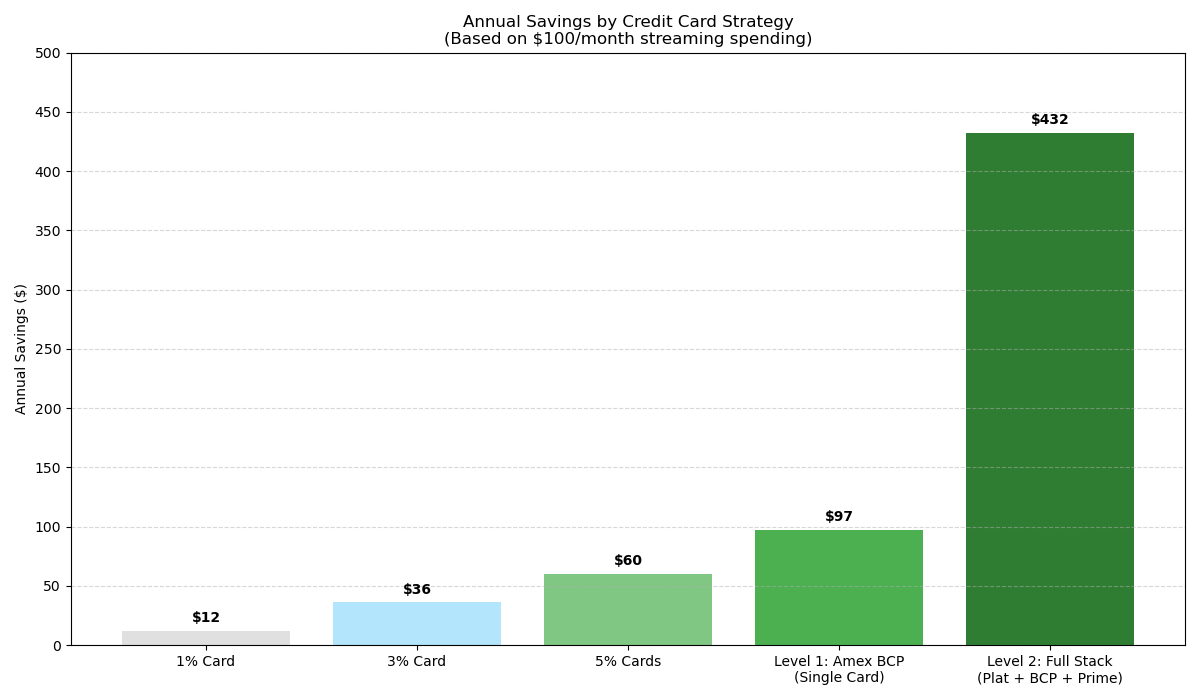
Annual savings by credit card strategy based on $100/month streaming spending
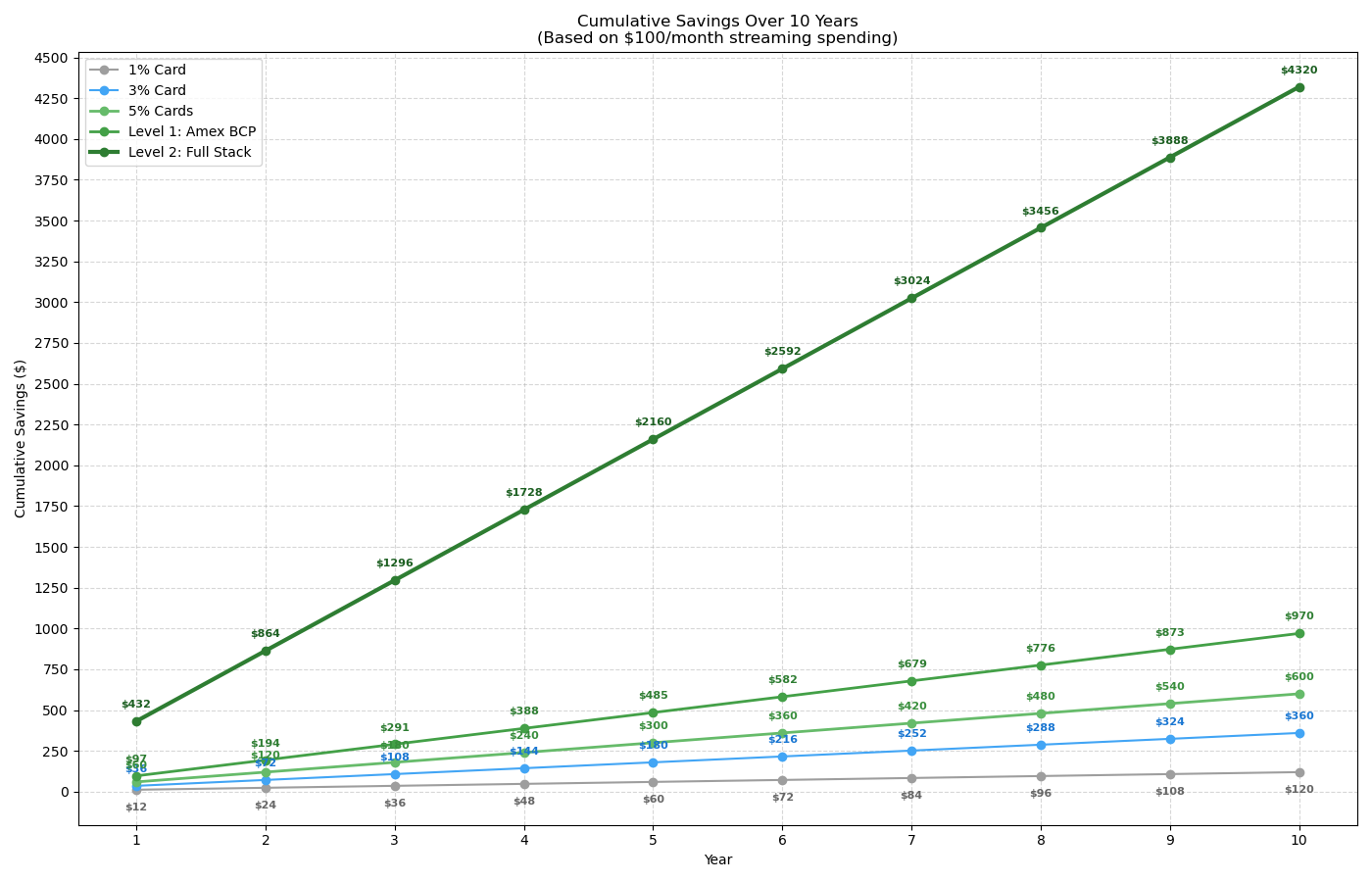
Cumulative savings over 10 years for different credit card strategies
| Strategy | Monthly Savings | 1 Year | 5 Years | 10 Years |
|---|---|---|---|---|
| No optimization (1% card) | $1.00 | $12 | $60 | $120 |
| Capital One Savor (3%) | $3.00 | $36 | $180 | $360 |
| 5% cards (Visa Max Cash, Cash+, Custom Cash) | $5.00 | $60 | $300 | $600 |
| Amex BCP (6% + credits) | $8.00* | $97* | $485 | $970 |
| Amex Plat stack + cashback (my setup) | $36.00** | $432 | $2,160 | $4,320 |
*Includes $120 Disney credit, minus $95 AF = net $25 + $72 cashback
The No Annual Fee Sweet Spot
If you refuse to pay annual fees, any 5% card (Visa Max Cash Preferred, US Bank Cash+, or Citi Custom Cash) is your ceiling. Over 10 years on $100/month streaming:
- 5% card: $600 saved
- 3% card: $360 saved
- Difference: $240
That $240 over a decade? That's a nice vacation. Or a new TV. Or just not feeling like you're getting ripped off. I know $36/year doesn't sound like much. But it's free money. And it adds up. That's why the 5% cards are worth the slight extra effort over "set and forget" 3% cards.
Check Your Carrier First: Don't Waste Credit Card Credits
Before you do anything else, check your phone bill. I wasted credits on Netflix for months before I realized T-Mobile already gave it to me. You know what's annoying? Paying for something you already get free.
Before optimizing with credit cards, check what streaming perks your carrier already includes. Some perks are hard to get elsewhere—don't waste credit card credits on services you can get free or heavily discounted.
Why streaming prices keep rising: Most services are still losing money. Content costs are massive. And investors want returns.
Carrier Streaming Perks Comparison
| Provider | Plan | Cost (1 Line) | Streaming Perks | Savings/Value | Unique Benefit |
|---|---|---|---|---|---|
| T-Mobile | Experience Beyond | $100/mo | Netflix Standard (ads): FREE Hulu: FREE Apple TV+: $3/mo |
~$25.97/mo value | Free Netflix is rare—hard to get elsewhere |
| T-Mobile | Experience More | $85/mo | Netflix Standard (ads): FREE Apple TV+: $3/mo |
~$10.98/mo value | Free Netflix + discounted Apple TV+ |
| Verizon | Bundle Add-ons | $10/mo each | Disney+ Bundle: $10/mo Netflix+Max: $10/mo Apple One: $10/mo |
33-50% off retail | Best customization—mix and match bundles |
| Metro | Flex Plus | $60/mo | Amazon Prime: FREE | $14.99/mo value | Taxes included, best for Prime users |
| Cricket | Supreme | $60/mo | Max (HBO): FREE | $9.99/mo value | Reliable AT&T network + Max |
| AT&T | Premium PL | $85/mo | None (20% Fiber discount if bundled) | N/A | Less valuable for streaming optimization |
Key Insight: Verizon bundles offer 33-50% savings (better than 5-6% credit card cashback). T-Mobile's free Netflix is rare. Check these first before using credit card credits.
Verizon Bundle Savings Breakdown:
- Disney+ Bundle (Disney+, Hulu, ESPN+): $10/mo vs $14.99/mo retail = 33% savings
- Netflix + Max Bundle: $10/mo vs $17.98/mo retail = 44% savings
- Apple One: $10/mo vs $19.95/mo retail = 50% savings
What to Use Credit Cards For (Based on Your Carrier)
If you have T-Mobile (free Netflix, Hulu, Apple TV+ $3):
- Use credit cards for: Spotify, YouTube Premium, Paramount+, Peacock, SiriusXM, Audible
- Don't waste credits on: Netflix, Hulu, Apple TV+ (already covered)
- Best card: Amex BCP 6% for remaining services, or 5% cards if you want no annual fee
If you have Verizon bundles (Disney+, Netflix+Max, or Apple One at 33-50% off):
- Use credit cards for: Services NOT in your bundle (e.g., if you have Disney+ bundle, use cards for Spotify, YouTube Premium)
- Don't waste credits on: Services already in your bundle
- Best card: Amex Platinum $25/mo credit for overflow services, then BCP 6% for everything else
If you have Cricket (free Max):
- Use credit cards for: Netflix, Disney+, Hulu, Spotify, YouTube Premium, Paramount+, Peacock
- Don't waste credits on: Max (already free)
- Best card: Amex BCP 6% or 5% no-AF cards
If you have Metro (free Amazon Prime):
- Use credit cards for: Prime Video add-ons, other streaming services
- Don't waste credits on: Base Amazon Prime membership
- Best card: 5% cards for other services
Other Free Streaming Credits
| Provider | Free Streaming Included | Notes |
|---|---|---|
| Xfinity | Peacock Premium | Gigabit internet or Diamond/Platinum rewards |
| Walmart+ | Paramount+ OR Peacock | Switch between them every 90 days |
| Instacart+ | Peacock Premium | Included with membership |
| Chase Sapphire Reserve | Apple TV+ and Apple Music | Through June 2027 |
Advanced Moves
Bundle Arbitrage: The Meta-Strategy
This is where it gets kind of ridiculous, but also kind of fun. This is over-optimization. But if you're already doing the other stuff, it's worth considering.
Bundle arbitrage = stacking credit card credits + carrier perks + streaming bundles to minimize out-of-pocket cost. This is how I get $1,000+ in retail streaming for ~$600/year.
Example optimal stack:
| Layer | Source | What You Get |
|---|---|---|
| Credit | Amex Platinum $25/mo | Disney+ Bundle with Max |
| Credit | Amex Platinum Walmart+ | Free Paramount+ OR Peacock |
| Carrier | T-Mobile | Netflix Standard (with ads) |
| Card Perk | Chase Sapphire Reserve | Free Apple TV+ and Apple Music |
| Cashback | Amex BCP 6% | Spotify, YouTube Premium, remaining services |
Result: Pay ~$50/month for ~$110/month in retail value.
Important: This only works if you already have these cards for other reasons (travel, groceries).
Advanced Tips:
- Bundle Billing Warning: If you have Disney+ Bundle with Max, bill it through Disney or Hulu, NOT Max.com. The Amex Platinum credit only triggers for Disney-billed subscriptions. Same bundle, different billing = different credit eligibility.
- Walmart+ Rotation: Your free Paramount+ from Walmart+ can be switched to Peacock every 90 days. Binge Paramount+ shows, switch to Peacock, repeat. This effectively gives you both services throughout the year.
Streaming Service × Card Matrix: What You Can Earn
Use this matrix to see exactly what benefit each card provides for each streaming service.
| Service | Amex Platinum | Amex BCP | 5% Cards* | Savor | Amazon CC |
|---|---|---|---|---|---|
| Netflix | 1x | 6% | 5% | 3% | 1% |
| Disney+ | $25 credit | 6% + $10 credit | 5% | 3% | 1% |
| Hulu | $25 credit | 6% + $10 credit | 5% | 3% | 1% |
| HBO Max | $25 credit | 6% | 5% | 3% | 1% |
| Paramount+ | FREE (Walmart+) | 6% | 5% | 3% | 1% |
| Peacock | $25 credit | 6% | 5% | 3% | 1% |
| YouTube Premium | $25 credit | 6% | 5% | 3% | 1% |
| YouTube TV | $25 credit | 6% | 5% | 3% | 1% |
| Apple TV+ | 1x | 6% | 5% | 3% | 1% |
| Prime Video | 1x | 6% | 5% | 3% | 5% |
| Spotify | 1x | 6% | 5% | 3% | 1% |
| Apple Music | 1x | 6% | 5% | 3% | 1% |
| SiriusXM | 1x | 6% | 5% | 3% | 1% |
| YouTube Music | $25 credit | 6% | 5% | 3% | 1% |
| Amazon Music | 1x | 6% | 5% | 3% | 5% |
| ESPN+ | $25 credit | 6% + $10 credit | 5% | 3% | 1% |
| Audible | 1x | 6% | 5% | 3% | 5% |
The Takeaway
- Disney ecosystem (Disney+, Hulu, ESPN+): Use Amex Platinum credit OR Amex BCP credit
- Amazon services (Prime Video, Music, Audible): Use Amazon CC for 5%
- Everything else: Amex BCP (6%) > 5% credit cards > Savor (3%)
Bottom Line
Here's what I actually believe: if you're not optimizing at all, you're leaving money on the table. But you don't need to go crazy.
The streaming credit card game has two levels:
Level 1 (Everyone): Use a 5-6% cashback card instead of your debit card or flat-rate card. Visa Max Cash Preferred, US Bank Cash+, or Citi Custom Cash (all free) or Amex BCP ($95) are the best options. Saves $60-100/year.
Level 2 (Premium card holders): Stack your Amex Platinum's $25/month entertainment credit + Walmart+ benefit, then use BCP for everything else. Saves $400-500/year, but only works if you already have the Platinum for travel.
I save $420/year with Level 2. If you already have an Amex Platinum for travel, you should too.
If you don't? The BCP at 6% + the Disney credit is still a solid net gain for a $95 investment.
Start with Level 1. See how it feels. Then decide if Level 2 is worth it for you.
Either way: stop charging streaming to a 1% card. That's just giving money away.
Frequently Asked Questions
What is the best credit card for streaming services?
The Amex Blue Cash Preferred offers the highest cashback rate at 6% on all streaming subscriptions, plus a $10/month ($120/year) Disney credit. The $95 annual fee is easily offset by the credit alone.
For no annual fee, the Visa Max Cash Preferred, US Bank Cash+, or Citi Custom Cash all offer 5% on streaming.
Does Netflix count as streaming for credit card rewards?
Yes. Netflix codes as a streaming subscription for all major cashback cards including Amex BCP (6%), US Bank Cash+ (5%), and Citi Custom Cash (5%).
What streaming services qualify for Amex 6% cashback?
Netflix, Disney+, Hulu, HBO Max, Prime Video, Apple TV+, Paramount+, Peacock, YouTube Premium, YouTube TV, Spotify, Apple Music, SiriusXM, ESPN+, and Audible all qualify for Amex BCP's 6% streaming cashback.
Is the Amex Platinum worth it for streaming?
Only if you already have it for travel benefits. The Platinum's $25/month entertainment credit covers $300/year of streaming, but the $895 annual fee doesn't make sense for streaming alone.
How much can I save on streaming with credit card optimization?
With a 5-6% cashback card, expect to save $60-72/year on $100/month in streaming. With premium card credits (Amex Platinum), savings can exceed $600/year.
What counts as streaming for credit card rewards?
Most cards include Netflix, Hulu, Disney+, Spotify, YouTube Premium, and HBO Max. Amex also includes App Store, Google Play, Audible, and SiriusXM (both streaming and satellite). Bundled subscriptions through cable or telecom may NOT qualify.
Do any credit cards give free Netflix?
No credit card offers Netflix completely free. The best option is the Amex Blue Cash Preferred with 6% cashback, effectively reducing a $15.49/month Netflix to $14.56. T-Mobile offers Netflix free on some phone plans.
Is it worth getting a credit card just for streaming?
Only if you spend $100+/month on streaming. At average spending ($69/month), the difference between a 5% card and 2% card (like Citi Double Cash or Wells Fargo Active Cash) is $25/year—not enough to justify a new application unless you'll use the card for other categories too.
Citations
- ↩ Deloitte Digital Media Trends 2025 (Accessed 2025-12-21)
- ↩ American Express Platinum Benefits (Accessed 2025-12-21)
- ↩ American Express Blue Cash Preferred (Accessed 2025-12-21)
- ↩ U.S. Bank Cash+ Categories (Accessed 2025-12-21)
- ↩ Citi Custom Cash Card (Accessed 2025-12-21)
- ↩ Capital One Savor (Accessed 2025-12-21)
- ↩ Chase Sapphire Preferred (Accessed 2025-12-21)
By Tree. Edited with assistance from Claude Sonnet 4.5 and Gemini 3.0 Pro via Cursor AI. Publishing script coded in Cursor AI with assistance from the same.